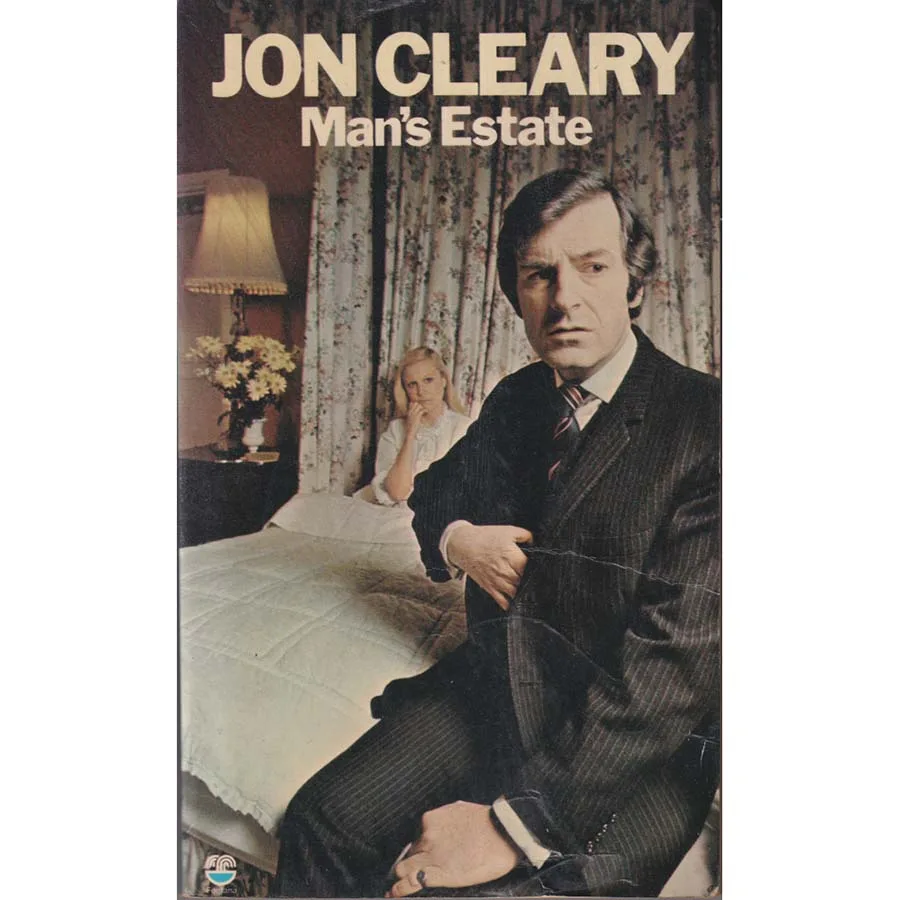
Mans Estate
Publisher: Fontana
Format: Paperback
ISBN: 0006136532
There are crime novels. There are political thrillers. And then there are Jon Cleary novels, which have a habit of taking ordinary people, placing them in extraordinary situations and then watching with considerable interest as everything becomes steadily more complicated.
Mans Estate, published in 1972 by Fontana, comes from one of Australia’s finest storytellers. Best known today for creating detective Scobie Malone, Cleary possessed a remarkable ability to blend suspense, social observation and human drama into stories that were both intelligent and thoroughly entertaining.
The title itself is wonderfully ambiguous. It could refer to property, inheritance, ambition, responsibility or perhaps the entire condition of being human. Knowing Cleary, there is a good chance it touches upon all of them before the final page is reached.
The novel explores themes of power, wealth, relationships and the complicated structures that people build around themselves. As events unfold, characters find themselves navigating a world where success and security are often less solid than they appear. The result is a story that functions both as a compelling narrative and as an examination of human nature.
There is a delightful irony in humanity’s relationship with possessions. People spend years acquiring estates, fortunes and status, only to discover that ownership rarely simplifies life. Literature is full of characters whose troubles begin the moment they acquire exactly what they thought they wanted.
What makes Cleary’s work particularly satisfying is his understanding of character. He rarely deals in simple heroes and villains. Instead, readers encounter believable individuals making difficult choices, often under considerable pressure. The resulting conflicts feel authentic because they arise naturally from personality rather than plot convenience.
Published in the early 1970s, the novel also captures a fascinating period of social change. The certainties of earlier decades were beginning to shift, creating fertile ground for stories about ambition, power and the fragility of established institutions.
Readers familiar with Cleary’s writing will recognise his gift for pacing. He knows when to build tension, when to reveal information and when to allow characters enough room to surprise both themselves and the reader. It is a skill that explains why so many of his novels remain enjoyable long after publication.
There is also something wonderfully old-fashioned about a thriller that relies on observation, character and storytelling rather than endless explosions. Cleary trusted readers to become invested in people, which remains one of the most reliable ways of creating suspense.
Modern readers may find themselves appreciating the novel both as entertainment and as a period piece. The world of 1972 feels close enough to recognise but distant enough to be fascinating, offering glimpses of attitudes and assumptions that have evolved considerably over the decades.
This 1972 Fontana edition remains in good condition and comes from the shelves of Crappy Old Books. It has weathered half a century admirably and remains a solid, readable copy of a novel by one of the twentieth century’s most accomplished popular storytellers.
An excellent acquisition for fans of literary thrillers, Australian fiction, vintage paperbacks or anyone who enjoys intelligent novels where human ambition proves every bit as dangerous as any criminal conspiracy. Thoughtful, engaging and quietly suspenseful, Mans Estate is another fine example of Jon Cleary’s considerable talents.
Keep browsing: See more Thrillers books Other books by Jon Cleary